ChatGPT for property descriptions. Claude to prepare buyer briefs before a viewing. A prompt to summarise a 40-page valuation report before the client call. Small tasks. One subscription. Useful but not essential.
Then something shifted. AI stopped being a drafting aid and started handling real operational weight: qualifying inbound leads against your mandate criteria, generating transaction summaries, preparing the first draft of an offer analysis, flagging inactive buyers in your pipeline who match a new listing.
At that point you are no longer using a tool. You are running part of your agency's operation through an external system.
That moment just cost Microsoft an entire year of AI budget.
What happened inside Microsoft
In December 2025, Microsoft gave thousands of engineers access to Claude Code. By May 2026, the bill had burned through the full annual allocation. Licences cancelled by June 30.
The engineers did not stop because it stopped working. They used it too much.
Uber: same pattern. 5,000 engineers. Adoption rates of 84 to 95 percent within months. Per-engineer API cost: 500 to 2,000 dollars a month.
Your team is not 5,000 engineers. The mechanism is identical. Token-based billing means the more useful AI becomes inside your agency, the higher the invoice. A 10-person team running AI through qualification, deal flow, client documentation, and weekly reporting does not spend the equivalent of 10 subscriptions at €20 a month.
That cost curve is still manageable. The harder problem sits underneath it.
Why renting AI infrastructure is a structural risk
The problem is not the cost alone. It is who controls the conditions.
Pricing. 65 percent of IT leaders report unexpected charges from consumption-based AI pricing. Enterprises routinely overspend three to five times their intended AI budget by month two. Token-based billing means your costs scale with adoption. The better your team uses the tool, the higher the invoice. There is no ceiling unless you set one. Once you have rebuilt your processes around a particular provider, the cost of switching is no longer zero.
Data. In March 2026, GitHub changed Copilot's default policy. Interaction data from Free, Pro, and Pro+ accounts (code, prompts, accepted suggestions, session patterns) now trains their models. Opt-out is available but is not the default.
For a developer, that means code snippets. For a luxury real estate agency, it means something materially different. Buyer qualification criteria. Off-market contacts. Mandate terms. Client acquisition logic. Pricing intelligence on transactions that never reach a portal. That operational data is the competitive advantage of a boutique agency. It is what separates you from a generalist. When it lives inside someone else's system, their privacy policy determines who else benefits from it. And that policy is a living document.
Business model. In January 2026, OpenAI launched advertising inside ChatGPT and crossed 100 million dollars in annualised ad revenue within weeks. The product your team uses to prepare client presentations and draft seller mandates now carries advertising interests. OpenAI's incentive is no longer purely to make the tool better for your agency. It is also to serve whoever is paying for placement inside the product.
When you run your operation on someone else's AI infrastructure, you are subject to their pricing decisions, their policy changes, and their business model evolution. None of these are in your control.
What a sovereign AIOS changes about the equation
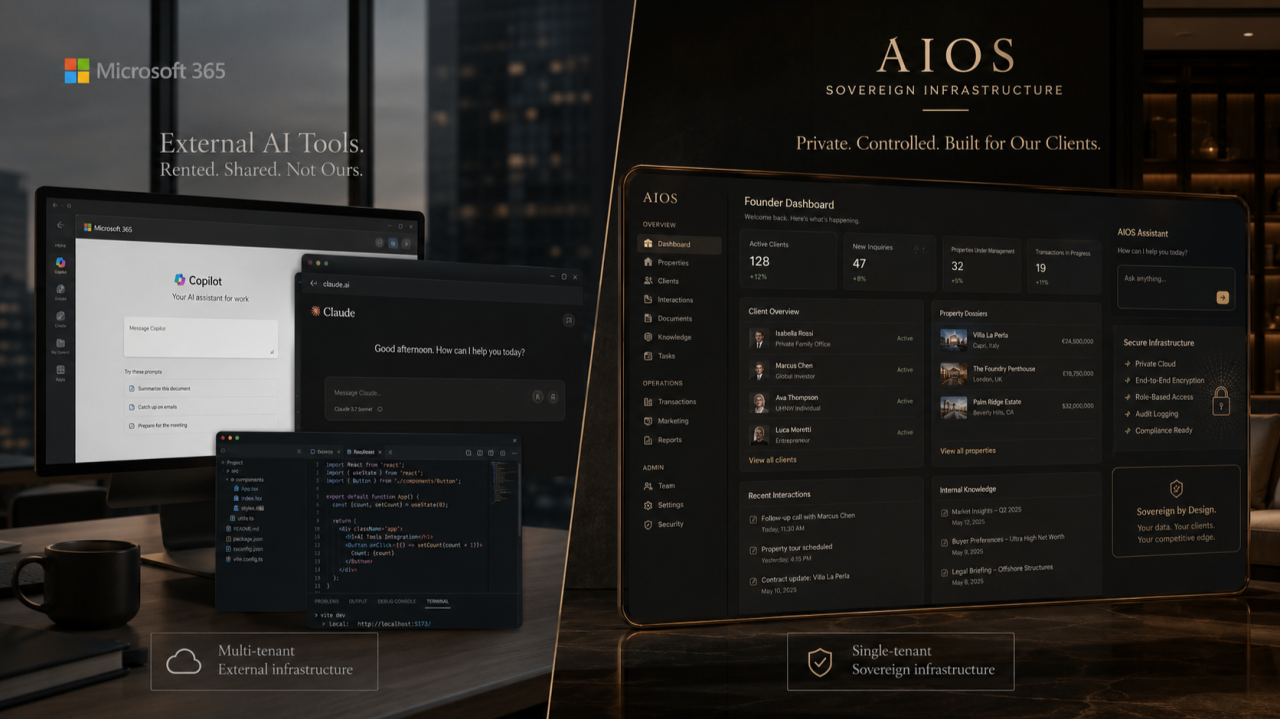
An AIOS (AI Operating System) is a platform built on your agency's actual operational knowledge: your processes, your team structure, your client files, your criteria. It runs on a hosted AI layer that you choose and can switch. It does not belong to a single AI provider. It belongs to your company.
The critical difference with off-the-shelf AI tools is the direction of adaptation. A generic AI tool is built for everyone. Your team adapts to it, learns its limitations, works around its defaults. An AIOS is designed for one agency. The knowledge, the agents, and the workflows are built around how your team actually operates. You do not adapt to it. It adapts to you.
This changes the equation on all three risks.
Pricing. You choose and negotiate the underlying AI model. If one provider raises prices, you migrate the system layer without rebuilding the operational knowledge layer. The value stays inside your infrastructure.
Data. Your operational knowledge lives inside your infrastructure. It does not feed their next model.
Business model. You are a paying client of the underlying AI model. Your relationship is commercial, not structural.
What this looks like inside a boutique agency
At Nücode AI we build AIOS platforms for luxury real estate agencies.
The architecture: five operational departments, fifteen specialised agents trained on the agency's actual data, three automated routines (daily founder brief, weekly report, inactive-buyer alerts), ten days to operational.
Measured outcome: eight to ten hours per week recovered per professional.
Setup: from €30,000 plus monthly retainer. Entry point for agencies that want to validate before committing: one department, from €6,000.
For reference: at 2,000 dollars per engineer per month, a team of ten using AI intensively spends 240,000 dollars a year on infrastructure that someone else controls.
The window
The agencies that build their AI infrastructure in 2026 will hold twelve to twenty-four months of operational advantage over those that wait for the market to stabilise. The market does not stabilise. The pricing tightens, the data policies shift, the providers consolidate. The agencies that own their operational layer compound. The ones running on someone else's stack absorb the cost of every change.
If the AI that runs your operation belongs to someone else, that is the conversation worth having.
→ alexandre@nucodeai.com
Quietly. Precisely. At scale.