
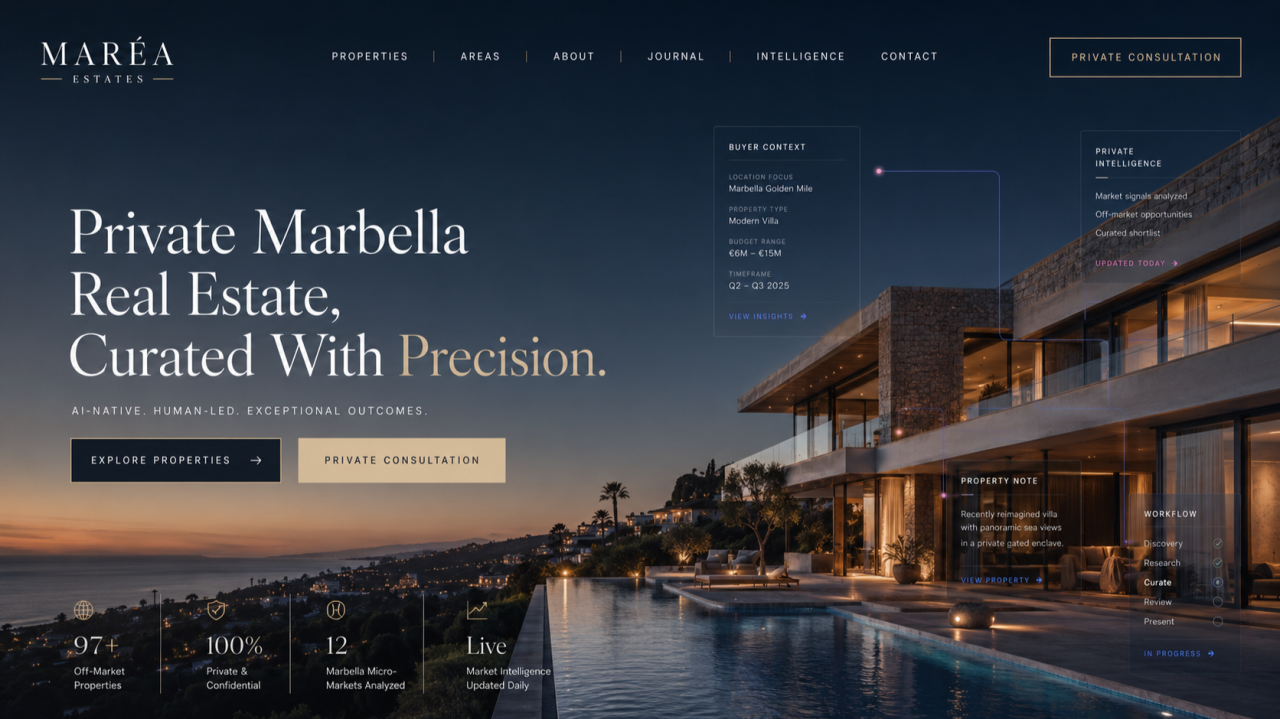
The strongest boutique agencies have always been built around human judgement. The founder reads which buyer deserves attention. The senior advisor reads silence in a negotiation. The good team reads the moment when a property should be shown, when it should be held back, and when a client needs precision rather than persuasion.
That layer remains the centre of luxury real estate. AI sits underneath it, amplifying it.
The change is happening underneath the relationship. The knowledge that makes an agency valuable can no longer stay scattered across inboxes, WhatsApp threads, CRM notes, listing folders, meeting memories, and the founder's head. As teams grow, buyers become more international, and expectations rise, the agency needs a way to preserve context without making the experience feel mechanical.
An AI-native luxury agency is built around that principle. AI sits inside the operating architecture: how the team remembers, prepares, responds, follows up, reports, and learns. The buyer still speaks to a human. The advisor is just better prepared.
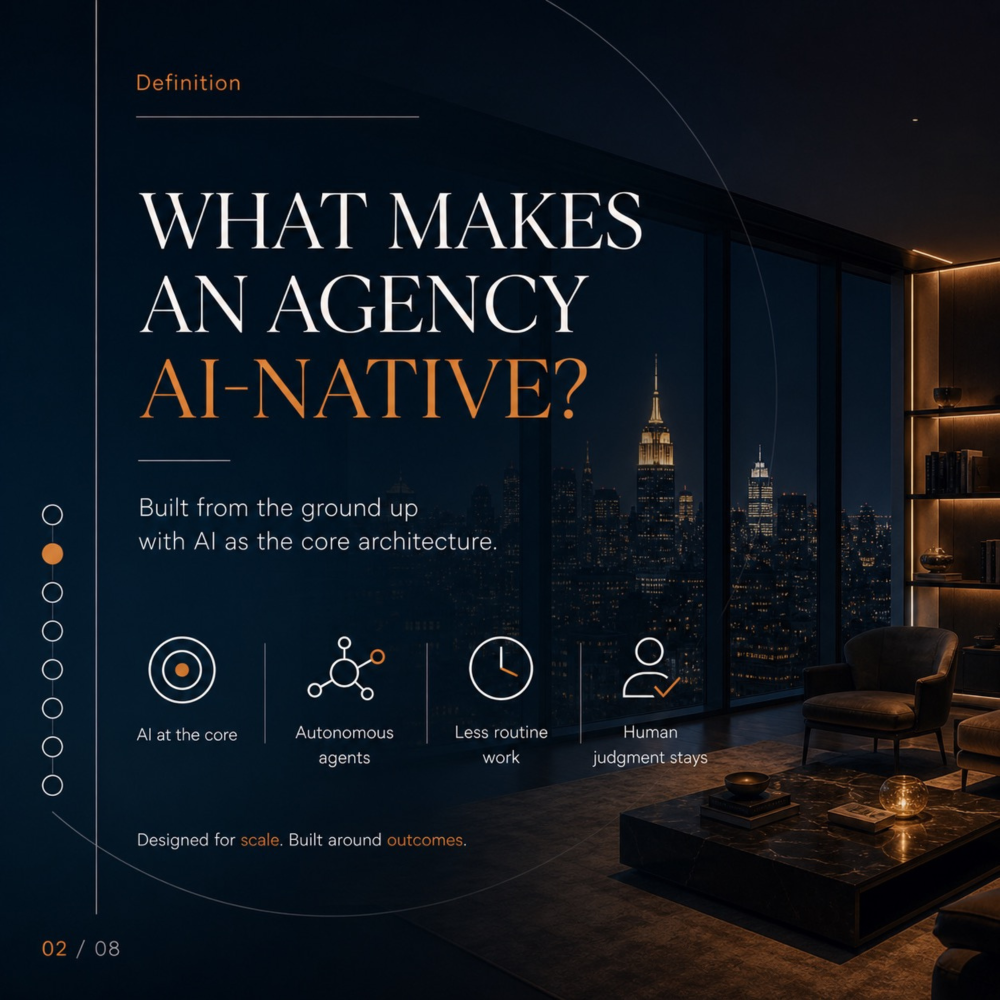
Tool vs. operating model
Most agencies are still using AI at the surface: a prompt for a property description, a meeting summary, a CRM note, a translation. Isolated outputs that do not change how the agency operates.
A tool improves one task. An operating model changes how work moves through the agency.
McKinsey's 2026 real estate research frames the same distinction. AI experiments such as lease summaries or faster memo drafting can help people become more effective, yet they rarely transform the work when they sit beside core workflows instead of inside them. The same analysis argues for redesigning entire domains rather than launching isolated use cases.
Five pressures shaping the category
1. The operational prize is large. McKinsey estimates AI applied to knowledge work could unlock $430 to $550 billion in annual value across real estate globally. In a luxury agency, the local version is rarely about saved hours. It is about preventing commercial loss: the buyer who waits too long for a reply, the seller who receives a weak update, the advisor spending two hours on what should have taken ten minutes.
2. Luxury clients expect personalisation without machine-feel. Vogue Business's 2026 AI consumer survey found 69% of respondents used AI chatbots, yet fewer than a quarter trusted AI recommendations and 55% actively distrusted them. The real opportunity sits in invisible AI: behind-the-scenes systems that support better service without forcing the client to interact with the machine. The client never feels the system. The advisor feels the leverage.
3. Privacy is becoming part of the luxury expectation. Buyer identity, family context, liquidity signals, relocation motives, tax considerations, and negotiation posture cannot be treated as generic CRM information. The question for a luxury agency shifts from "can AI help us?" to "where does our intelligence live, and who controls it?"
4. Wealth flows are converging around AI. Reuters reported in June 2026 that European luxury brands are sharpening their focus on AI-enriched U.S. wealth, with North America accounting for around 27% of global luxury store openings in 2025. J.P. Morgan's 2026 Global Family Office Report, based on 333 offices across 30 countries, found 65% of family offices plan to prioritise AI, with inflation-concerned offices allocating close to 60% to alternatives.
5. The buyer base is changing. A German industrial family, a U.S. AI founder, a Gulf investor, a Swiss family office, and a Latin American entrepreneur do not read the same property the same way. An AI-native agency adapts around these differences without forcing the advisor to rebuild context from zero every time.
What an AI Operating System actually does
Most agencies will try to answer the shift by buying more tools. Each one may help. Together, they fragment further. Another tab, another dashboard, another place context can be lost.
The Nücode AIOS is built from the opposite direction. It starts with the agency itself: its voice, its portfolio, its buyers, its operating standards, its commercial rhythm. The AIOS turns that into a private AI platform owned by the agency.
The architecture has four layers:
Context holds the agency's voice, buyers, properties, standards, and internal judgement.
Connections integrate the CRM, calendar, meetings, documents, and operational tools already in use.
Capabilities turn context into work: buyer briefs, property dossiers, market summaries, follow-ups, owner updates, pipeline reports.
Rhythm keeps the system alive: daily priorities, weekly pipeline, monthly reviews, continuous improvement.
The compounding starts when those layers connect. A property brief improves because the system knows the buyer. A follow-up improves because the system remembers the meeting. A weekly report improves because the system sees the pipeline. A founder decision improves because the system has preserved the context. A team improves because everyone works from the same source of truth.

The thesis
The advisor remains the relationship layer. The founder remains the judgement layer. The AIOS becomes the operating layer.
The category will be defined by the agencies that build the clearest private intelligence layer around their knowledge, clients, properties, and team.
If the operating layer of your agency still lives in the founder's head, the inboxes of the senior advisors, and the corners of a CRM no one fully uses, that is the conversation worth having.
→ alexandre@nucodeai.com
Quietly. Precisely. At scale.