

After last issue's framework overview, several of you asked the same question in different ways: what does each phase actually look like when it runs? Not in theory — in a real agency, with real advisors, on a real Tuesday.
Phase 1 — Find Out What You Actually Have
The first step has nothing to do with technology. It's an audit.
Before any system gets built or any tool gets deployed, someone on your team needs to spend two to three weeks answering one question honestly: where does your client information actually live?
Not where it should live. Where it actually is.
The answer, in virtually every boutique agency we've spoken to, is the same: names and transaction values in the CRM, deal notes in a spreadsheet, real context — who the client is, what they care about, what motivated their decision — living in the advisor's head and their WhatsApp history.
That is not a foundation. It's archaeology.
The output of Phase 1 is not a clean database. It's a map of the gap: here is what exists, here is what format it's in, here is what's missing, here is where the risk sits.
The example:
A boutique agency in Marbella completed this audit and found that of 62 past transaction clients, 51 had no contextual information beyond a name and a closing date. The agency had been running cold outreach campaigns to acquire new HNWI leads while sitting on 51 warm relationships with documented buying capacity — they just couldn't see them because the data was invisible.
The audit didn't fix anything. It made the problem impossible to ignore.
Phase 2 — Write Down How Work Actually Happens
This is the phase where agencies say "we know our process" and move on. That's the mistake.
Knowing your process in your head is different from documenting it. The documentation reveals gaps that intuition hides: the moments where information gets lost because one person is on holiday, the decisions that only get made correctly when the founder is in the room, the tasks that happen inconsistently depending on which advisor is handling them.
Process mapping doesn't require a consultant or a whiteboard session. It requires three honest conversations with your team about how leads actually move from first inquiry to first call, how properties get matched to buyers, how investor clients get updated. Not the ideal version — the real version.
The questions that matter: what triggers each task, who does it, how long does it take, and where does quality most often drop?
The example:
An agency in Barcelona mapped their lead management process for the first time and discovered that the same lead was being handled by two advisors simultaneously — with no shared awareness. One of those leads had received four contacts in a single month from the agency's side. The client had gone silent. No one understood why until the process was drawn out on paper.
The fix took one afternoon. But it only became visible because someone had done the mapping.
Phase 3 — Test One Thing, Properly, Before Doing Everything
This is where technology enters — but only in one workflow, with a small group, for a defined period.
The most effective starting point for most boutique agencies is lead preparation: the work that happens between a new contact arriving and the first meaningful conversation. Right now, that work takes between 45 and 90 minutes per lead and produces inconsistent output depending on who does it and how much time they have.
The pilot runs for 30 days. One workflow. Three advisors. Every lead that enters the pipeline goes through a structured enrichment process — profile, motivation, budget, relationship entry point — before the first call. The advisor reviews it, adjusts where needed, uses it to prepare.
The pilot is not declared successful because advisors found it useful. It is declared successful when four numbers move: time spent per lead goes down, first-call-to-second-conversation rate goes up, advisors arrive at calls with genuine context, and clients respond differently.
Those four numbers are defined before the pilot starts. Not after.
The example:
A three-advisor agency in Madrid ran this pilot on 22 leads over 30 days. Time per lead dropped from an average of 68 minutes to 11 minutes. First-to-second conversation conversion went from 31% to 49%. One advisor described the shift simply: "I stopped arriving curious and started arriving prepared. Clients can feel the difference."
That agency moved to the next phase on day 31. With data, not faith.
Phase 4 — Make the System Part of How the Agency Runs Every Day
A pilot that worked but isn't embedded into daily operations is just a good experiment that fades. Phase 4 is where the system stops being something advisors use occasionally and starts being the way the agency operates by default.
Three things get formalized. The lead intelligence workflow from the pilot gets applied to every lead without exception. The same systematic approach extends to two adjacent areas that suffer from identical problems: investor client reporting and post-viewing follow-up — both done inconsistently today, both fixable with the same underlying logic. And one person on the team takes ownership of output quality — a 30-minute weekly review role, not a technical position.
When these three areas are running in parallel, the agency has something worth naming. We call it the Nücode Operating System — one layer handling the administrative and documentation load, one managing lead intelligence and prioritization, one giving leadership a real-time view of pipeline health and advisor performance. Not three separate tools. One operating model with three interconnected functions.
The example:
An eight-advisor agency in Marbella completed this phase over nine weeks. In the first month of full operation, advisors recovered 74 hours collectively — not projected, counted — that had previously gone to lead research, client documentation, and report preparation. The founder's summary at the end of month one: "I stopped being the person who remembers things for everyone else."
Phase 5 — Use What the System Has Learned
By the time Phase 5 begins, the system has been running for at least 90 days. It has processed leads, prepared briefs, tracked outcomes. In doing so, it has quietly built something no competitor can purchase: proprietary intelligence about your specific agency's buyers, patterns, and market.
This is where the investment starts returning more than time savings.
The accumulated data can now be analyzed to surface patterns no individual advisor would notice: what motivations appear most consistently in clients who close, what objections recur in those who don't, how buyer profiles have shifted in the last six months, which elements of a first conversation correlate most strongly with a client requesting a second. That is not generic market research. It is your data, about your buyers, interpreted for your market. It compounds with every new transaction, every brief, every follow-up cycle the system processes.
The founder's role changes as a result. The operational questions — how do I keep the pipeline organized, how do I make sure advisors are preparing properly, how do I produce investor updates on time — have systematic answers now. The question moves up a level: which direction should the agency grow, where is the market moving, what does our own data suggest about where demand is building before the broader market sees it.
The example:
An agency at the six-month mark of Phase 5 analyzed their accumulated buyer briefs and found that 62% of closed transactions in the prior year involved buyers who had mentioned one specific lifestyle signal — school-age children and proximity to an international school catchment — that had never been systematically captured before. They adjusted their listing narratives and buyer brief structure to lead with that signal for the relevant segment. First-call-to-viewing conversion on that segment improved by 22 points in the following quarter.
They didn't guess at that change. The system showed them where to look.
The sequence, plainly:
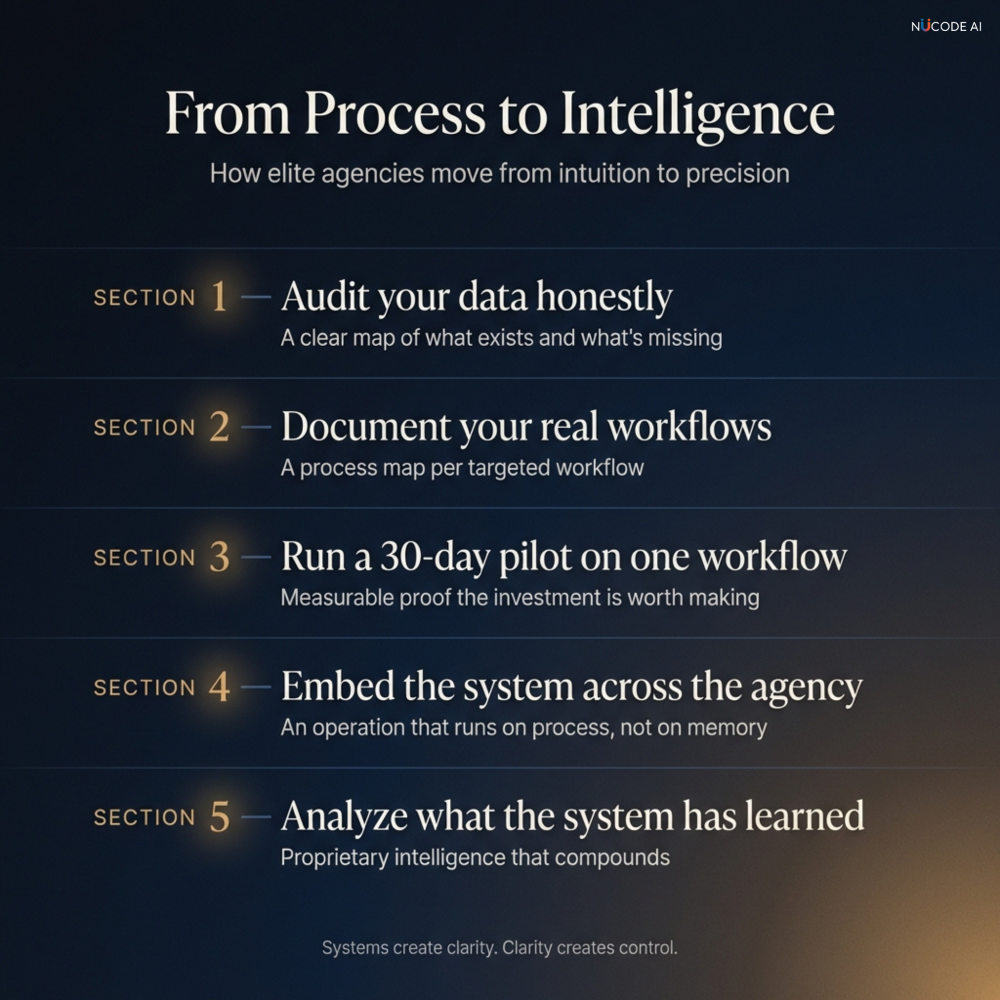
The agencies that have moved through this sequence didn't do it because they had larger budgets or more technical teams. They did it because someone decided the order mattered — that you can't skip the foundation and expect the roof to hold.
The ones still running one-off AI experiments are not failing for lack of tools. They're failing for lack of sequence.
If you want to understand where your agency stands before AI becomes infrastructure, the starting point is the Nücode Scorecard. Nine questions, no email gate, and an instant benchmark.
→ alexandre@nucodeai.com