
Across conversations with luxury real estate leaders, one question keeps returning: where should AI enter the firm?
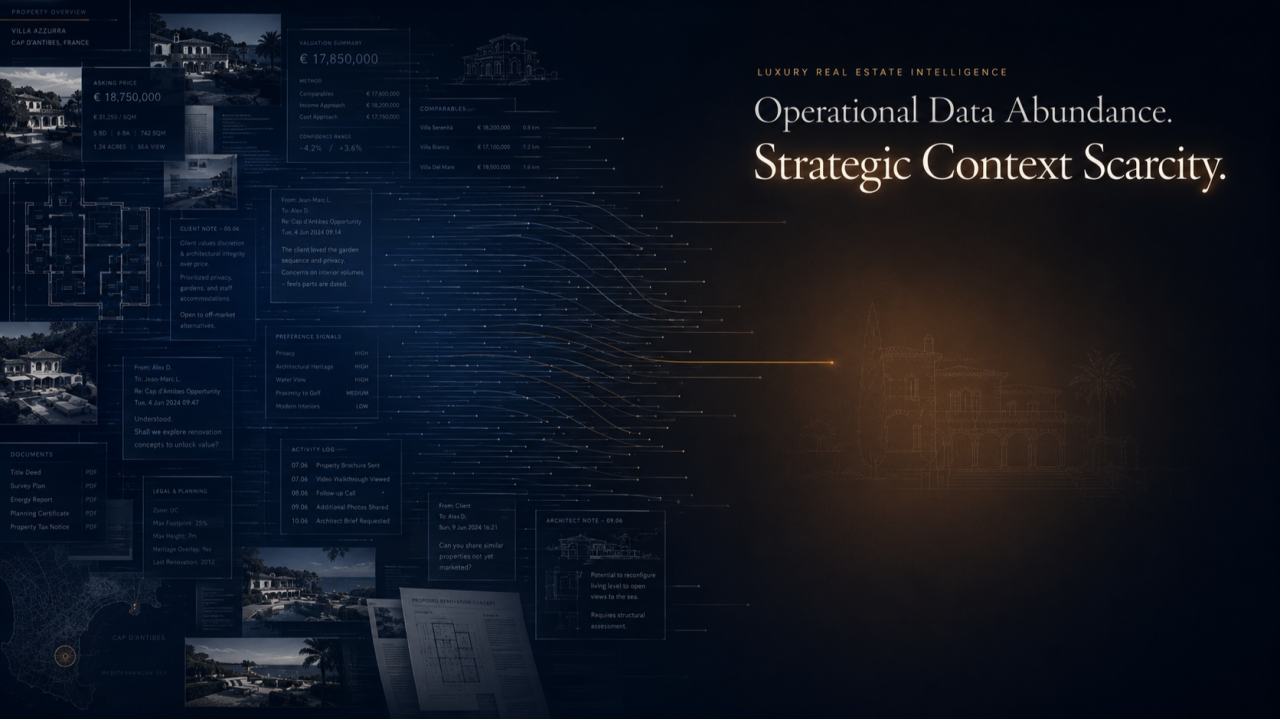
It is the right question, but it is often asked too late. By the time a firm is comparing tools, its teams may already be carrying the same information between inboxes, calendars, CRMs and private conversations. Decisions wait for the founder because the context needed to make them is scattered. The operation looks personal because it is personal, but too much of it has become dependent on one person being present.
The opportunity is not to place AI in front of the client as quickly as possible. It is to build the intelligence around the moments that deserve a human being.
Start with context, not software
Before selecting a model, a platform or an automation, a firm needs an honest picture of its operating context. Where does information live? Where does a handover lose detail? Which questions repeatedly arrive at the founder? Which decisions are delayed simply because no one can see the full picture?
These are not technology questions. They are questions about how the firm currently works. Their answers reveal where an intelligence layer can make a genuine difference and where technology would only add another interface.
A good starting point is rarely the most visible task. It may be preparing the buyer brief before a viewing, assembling the history of a relationship before a call, identifying the next action after a negotiation, or ensuring a request does not disappear between departments. This is work that requires context, consistency and speed, not a substitute for judgment.
What the system should carry
AI is well suited to retrieve information, prepare briefs, organize a record, draft communication and surface decisions that require attention. Used carefully, it removes the operational weight that surrounds a high-value interaction without changing the interaction itself.
- Bring relevant property, client and conversation context into one preparatory brief.
- Draft a first version of communication in the firm's voice for human review.
- Identify incomplete records, overdue follow-ups and decisions without a clear owner.
- Route internal requests so the right person has the required context before acting.
None of this diminishes the role of the advisor. It protects it. The more effectively a firm handles the work around its relationships, the more present its people can be when discretion, taste and timing actually matter.
What must remain human
Luxury real estate continues to depend on relationships, empathy, physical presence and judgment. A system may recognize that a client has gone quiet or that a negotiation needs attention. It cannot carry the responsibility of reading the room, choosing the moment to call, or deciding how a sensitive conversation should unfold.
The same boundary applies to negotiation, commitments and final decisions. Accountability cannot be automated away. The person responsible for an outcome must remain responsible for the decision.
AI should carry the operational weight surrounding the relationship, not replace the relationship itself.
The boundaries must be designed
Trust does not emerge from a tool. It comes from explicit boundaries that the firm can explain to its team and clients: what may the system access, what requires verification, which actions need approval, and what should remain entirely human?
Without these answers, a deployment becomes either too open to be trusted or too restricted to be useful. With them, the firm can move faster without becoming careless. The system knows its role, the team knows when to intervene, and the founder is no longer the sole container of the operation.
Lead the intelligence
The firms that gain from AI will not be those that introduce it most visibly. They will be those that decide, with precision, where intelligence belongs and where it does not.
That requires leadership. It means mapping the operation before automating it, protecting the information that makes the firm distinctive, and keeping human judgment at the center of every consequential decision.
We must lead AI, not be led by it. In luxury real estate, that is not caution. It is the standard.